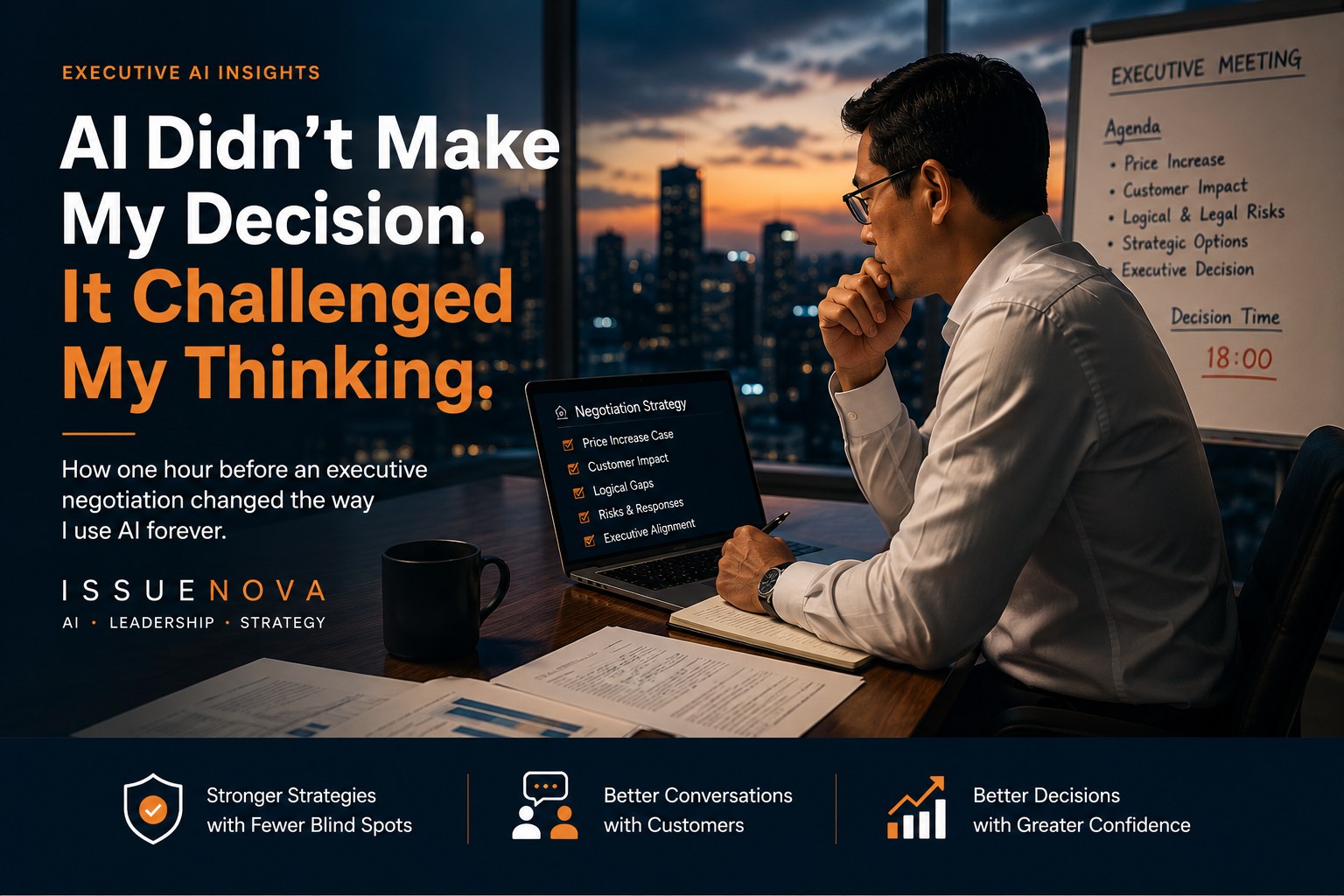

This article explores AI executive decision making through a real executive negotiation experience
ISSUENOVA ORIGINALS
Executive AI Series · EA-001
- AI challenged my assumptions before I challenged my customer.
- Verification created confidence in executive decision-making.
- Better thinking led to better conversations.
- AI strengthened my executive judgment— it never replaced it.
The Problem wasn’t having only one hour.
It was making a decision that could affect the business for months.
The Situation
It was exactly 5:00 PM.
One hour later I would be presenting a negotiation strategy to our Country managing Director and the director of our Asia region.
This wasn’t a routine project update. It was a business decision that could directly influence the profitability of one of our product lines.
For months, rising raw material costs had continued to erode our margins. Global uncertainty had pushed imports costs even higher, and the existing commercial agreement no longer reflected reality.
Management wasn’t looking for another explanation. They expected a strategy.
Normally, preparing that kind of presentation would take an entire day. Instead, I had one hour. Not because I procrastinated. Because like many managers, my day belonged to everyone else—customer calls, internal requests, urgent emails, unexpected issues.
Every interruption demanded immediate attention, and every conversation seemed more urgent than the presentation I still hadn’t prepared.
When the office finally became quiet, I looked at the clock 5:00 PM.
That was when I opened ChatGPT.
Not to write my presentation, but to challenge my thinking.
It required structured thinking.
The Real Challenge Wasn’t Time
People often assume the biggest challenge in leadership is a lack of time. I disagree. The real challenge is maintaining the quality of your decisions when time disappears.
The negotiation itself was already complicated. Our company needed a price adjustment because production costs had risen significantly. Material prices, geopolitical uncertainty, and higher imports costs were putting increasing pressure on profitability.
At the same time, our customer had its own commercial priorities. Both sides had logical arguments. Both sides believed they were right.
Finding a solution required more than data.
I Didn’t Ask AI to Write My Presentation
Most discussions about AI focus on productivity. People ask AI to summarize documents, write emails, or generate presentations.
That wasn’t what I needed.
I gathered everything I had. Customer meeting minutes, Email exchanges, Internal discussions, Commercial history.
Then I uploaded those materials and gave AI a very specific instruction.
“Based on these documents, identify the likely negotiation scenarios, analyze the logical weakness in the customer’s requests, evaluate potential business risks, and prepare an executive summary for management.”
That prompt became the starting point — not the final answer.
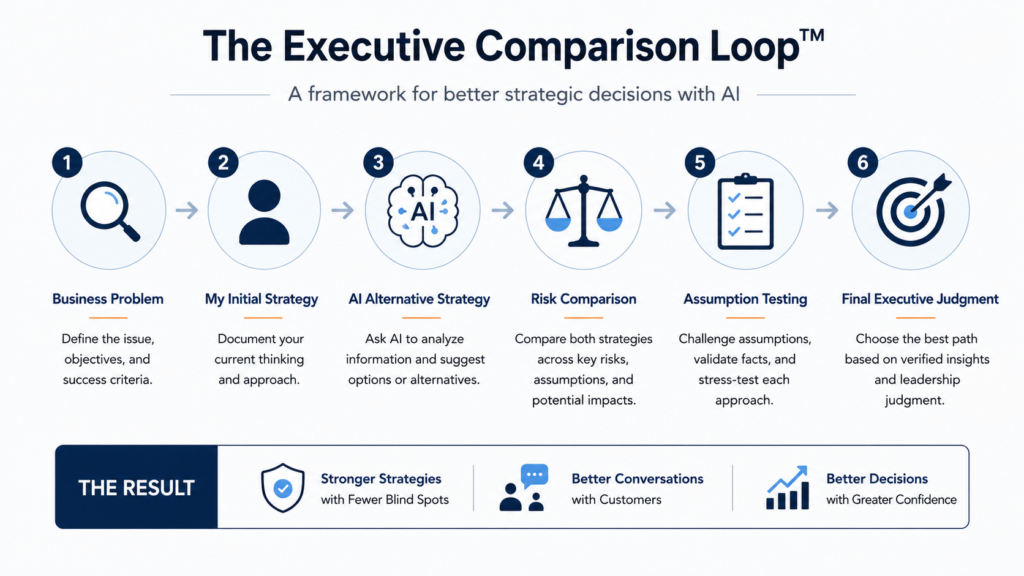
IssueNova Framework 01
The Executive Comparison Loop
A practical framework for validating executive decisions with AI.
AI Became My Strategic Challenger
Many people assume AI provides answers. That isn’t how I use it.
The first response is only the beginning.
I usually continue the conversation five to ten more times.
Every recommendation goes through another round of questions.
Is this supported by facts?
Can I verify this assumption?
What would happen if the customer rejected this approach?
What legal or commercial risks remain?
What arguments might management challenge?
Each iteration strengthens — or weakens — the original recommendation.
Only after testing those ideas against reality do I decide whether they deserve a place in my strategy.
Over time, I realized something important.
AI wasn’t replacing my judgment.
It was exposing the weakness in my own thinking before someone else did.
Verification Creates Confidence
One misconception about AI is that using it means accepting its answers. That is not how I work. Every recommendation must be challenged. Every assumption must be verified. Only after testing AI’s suggestions against real business conditions do I include them in my strategy. Ironically, the more I question AI, the more valuable it becomes. Verification creates confidence. And that confidence improves the quality of AI executive decision making.
What Happened Next
The executive discussion went well. Management appreciated that the presentation went beyond describing the problem. It explained possible customer reactions, highlighted logical inconsistencies in the customer’s position, and identified legal and commercial risks that required careful consideration. There were difficult questions. What if the customer rejected every proposal? Could stronger arguments damage the relationship? Would a more aggressive position slow future negotiations? Those discussions made the strategy even stronger. Later, the issue reached the customer’s executive leadership. Previously, the discussion had remained at the working level with little progress. The improved strategy didn’t guarantee success. But it changed the quality of the conversation. For me, that became an important lesson. Better thinking creates better business discussions.
Executive Reflection
Looking back, I realized that AI never made the decision for me. What it did was challenge my assumptions before I walked into the meeting. The final decision was still mine, but it became a better decision because my thinking had already been challenged. That experience fundamentally changed how I approach AI executive decision making.
Since then, AI has become an essential part of my leadership process – not my providing answers, but by helping me ask better questions. The meeting changed more than one negotiation. It changed the way I approach every important business decisions.
Whenever I face a complex commercial issue, I no longer ask AI for answers. Instead, I ask AI to challenge my assumption first. That simple shift has consistently improved the quality of my executive decisions.
The most valuable outcome wasn’t a successful presentation – it was discovering a better way to think before making important business decisions. That lesson continues to influence every major negotiation I lead today.
Executive Takeaway
The biggest lesson wasn’t about AI. It was about leadership. Strong leaders don’t look for technology to replace their judgment. They look for tools that strengthen it. When used correctly, AI doesn’t make executive decisions. This is where AI executive decision making creates real value: improving the quality of executive thinking before decisions are made. Better AI executive decision making begins with better executive thinking.
Continue the Executive AI Series: Preparing for the Decision, Not Just the Meeting
IssueNova Insight
AI creates value long before a decision is made. Its greatest contribution isn’t generating answers. It’s challenging assumptions, exposing blind spots, and helping leaders think more critically before important business conversations begin.
About IssueNova
IssueNova shares real-world executive experiences, practical AI applications, and strategic business insights from the automotive industry. Each Experience Article transforms actual leadership situations into practical frameworks that professionals can apply to make better business decisions.
Experience inspires frameworks.
Frameworks inspire better decisions.