

When the forecast stayed unchanged but reality kept shifting, the challenge wasn’t predicting the future. It was deciding what evidence was strong enough to act on.
ISSUENOVA ORIGINALS
Executive AI Series · EA-003
For me, AI decision making under uncertainty began with what sounded like a simple question from management:
“What happens to our budget volume?”
There was no simple answer.
A sudden supply disruption was creating uncertainty across our operations. Our customer was already working on short- and long-term measures to stabilize the situation. But in the early stage, those measures had not yet taken full effect, and daily requirements continued to change. The timing of normalization remained unclear.
Volume was not just a sales number. It affected production, inventory, manpower, and ultimately our financial outlook.
Management needed a view they could use.
The problem was that the information I normally relied on wasn’t giving me a clear answer.
1. When the Numbers Stopped Telling the Same Story
My first step was to go back to the customer.
I asked my sales team to get the latest view of their volume forecast.
The official forecast remained unchanged.
But what we were seeing operationally was different. In the early stage of the disruption, the short- and long-term measures had not yet fully stabilized the situation. As a result, actual daily requirements continued to fluctuate, and the required volumes for individual programs were changing frequently.
That put me in an uncomfortable position.
The most authoritative planning reference available to us was giving me one view, while the daily operational reality was showing a different pattern.
Which signal should I trust enough to take to management?
I did not know why the forecast remained unchanged. Without evidence, I didn’t want to create an explanation of my own.
What I knew was simpler:
- The official forecast had not changed.
- Actual requirements were fluctuating
- We did not yet know how long the disruption would last.
That was a starting point, but not yet an answer I was comfortable taking to management.
2. Management Still Needed an Answer
The company could not wait until the uncertainty disappeared.
Looking back, the situation seemed to leave us with three broad approaches.
Use the customer’s official forecast directly
It was the most authoritative planning reference available, but using it directly for production planning would not fully reflect the operational uncertainty we were seeing day to day.
Use a lower internal assumption
That might appear more conservative. But without sufficient evidence, we could simply be replacing one uncertain assumption with another.
Wait for more information
We could wait for the customer to revise its forecast or for the supply situation to become clearer.
But production, inventory, manpower, and financial planning could not wait with us.
Doing nothing was also a decision.
If you had been responsible for the recommendation at that moment, which option would you have chosen?
For me, none of the three was strong enough on its own.
I needed to change the question.
Instead of:
“What is the correct forecast?”
I began asking:
“What assumption is best supported by the evidence we have today?”
That was something we could actually work on.
3. I Needed More Than One Signal
One forecast was not enough.
But replacing it with my own assumption would not make the decision any more reliable.
I needed different signals that could challenge one another.
So I began building the picture from several directions.
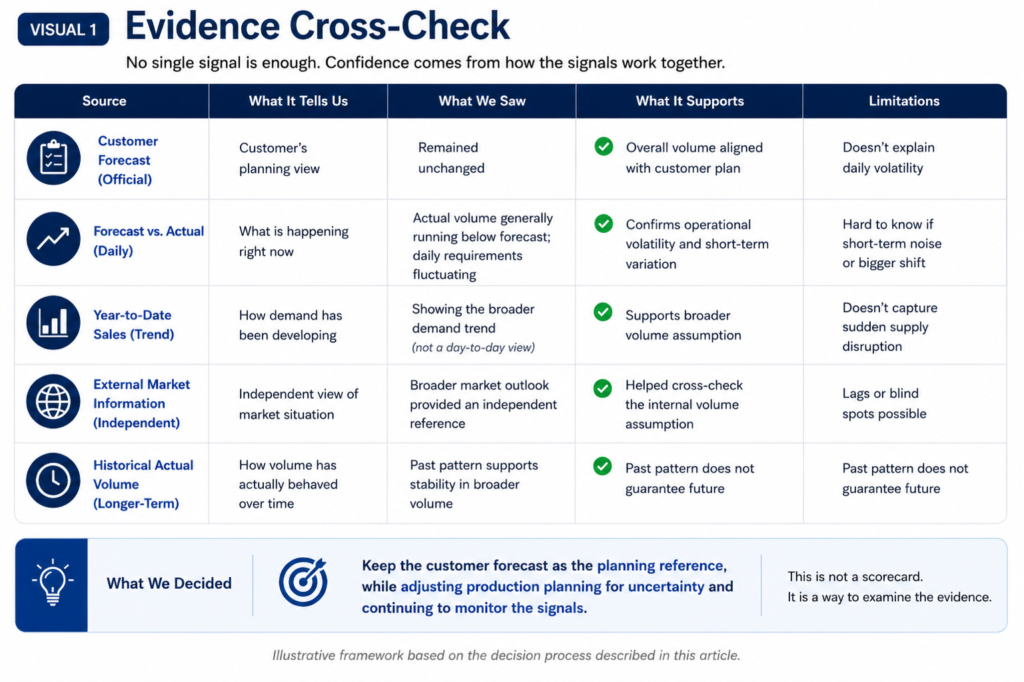
- Customer forecast: the official volume outlook remained unchanged.
- Forecast vs. actual: actual volume was generally running below forecast, while daily requirements continued to fluctuate.
- Year-to-date trend: sales and volume movement from the beginning of the year helped show how actual demand was developing.
- External market outlook: I compared the internal picture with independent global market forecasts to see whether the broader market outlook pointed in the same direction.
- Historical actuals: three years of actual volume provided a longer-term reference for judging whether the current pattern was unusual.
I also followed the latest developments around the disruption and the measures being taken toward normalization.
None of these sources could tell me exactly what would happen next.
But together, they could tell me whether my working assumption was becoming more—or less—credible.
That distinction became important.
4. AI Didn’t Give Me the Answer. It Helped Me Challenge My Thinking.
This was where AI became useful.
Not because it could predict the final outcome.
I used it to work through the uncertainty faster and more systematically.
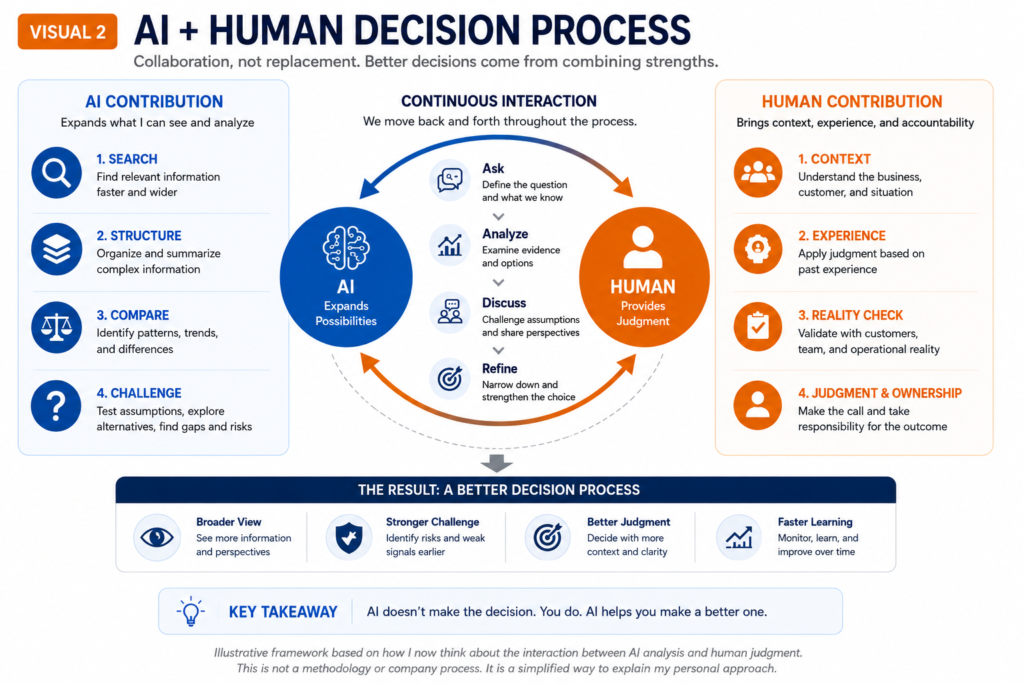
- Gather: organize publicly available information and recent developments that could affect the situation.
- Compare: examine forecasts, actual results, market trends, and historical patterns side by side.
- Challenge: test my assumptions and look for evidence that could contradict them.
- Explore: develop alternative scenarios instead of relying on a single expected outcome.
AI expanded the analysis. It did not own the decision.
I explored this distinction more directly in an earlier article, “AI Didn’t Make My Decision. It Challenged My Thinking.”
I still had to decide which information was credible, which assumptions were reasonable, and what level of risk the company should actually take.
So I did not treat AI output as evidence by itself.
This is also consistent with broader guidance on responsible AI use, particularly the importance of human review and verifying critical information.
I checked AI-generated analysis against public information, discussed its assumptions with my team, and compared it with what we were actually hearing and seeing through customer discussions and daily operations.
When the signals did not agree, I did not force them into a single conclusion. The disagreement itself became something to investigate.
That process did not eliminate uncertainty.
It made the uncertainty more manageable.
5. We Didn’t Need Certainty. We Needed a Working Plan.
By this point, I still could not say exactly how the situation would unfold.
But I had enough evidence to make a recommendation.
The customer’s official forecast remained unchanged. But while the situation was still unstable, using that forecast directly as our production plan would not have fully reflected the operational uncertainty we were seeing.
So we did not try to replace the customer’s forecast with another forecast of our own.
We kept the customer forecast as our reference, but adjusted our production planning to reflect the level of uncertainty we were seeing.
Those adjustments were not arbitrary. They were informed by the signals I had been cross-checking: actual volume versus forecast, year-to-date trends, independent global market forecasts, historical actuals, and the latest developments around the disruption.
AI helped me examine those signals more systematically, challenge the assumptions behind them, and explore alternative scenarios. But deciding how much risk to reflect in the plan remained a human judgment.
The objective was not to predict the exact volume. It was to build a production plan that could better manage the uncertainty.
We used that risk-adjusted planning approach as the basis for production and operational planning, while continuing to monitor the signals that could change our view.
As the situation evolved, the plan could evolve with it.
This gave our operations teams a more practical basis for production, inventory, and manpower planning while the customer continued working toward normalization.
It also gave management something more useful than a single forecast number: a clear view of what we knew, what remained uncertain, and how we were planning around that uncertainty.
The strength of the plan was not that it predicted the future correctly. It was that it gave us room to adjust as the evidence changed.
6. What Changed After I Started Using AI
Looking back, the biggest change was not that AI gave me better answers.
It changed how quickly and systematically I could get to a decision I was willing to stand behind.
Before AI
Before AI, gathering and structuring the information required more manual work. My team and I would compare the available data, discuss different interpretations, and gradually build a view of the situation.
The process worked, but it took time. And under pressure, there was a risk of giving too much weight to the information that was easiest to access—or that supported what we already believed.
With AI
I could gather and structure information faster, compare multiple signals more systematically, test alternative explanations, and challenge my initial assumptions before taking them to my team.
That meant our discussions could start at a different level.
Instead of spending as much time assembling information, we could spend more of it questioning the assumptions, discussing the risks, and deciding what action made sense.
AI did not shorten the decision by removing human judgment. It shortened the path to better human judgment.
What Didn’t Change
The responsibility for the decision remained with me.
AI could expand the analysis, but it only knew the context and information I gave it. Its output could also be wrong, incomplete, or biased.
That is why the final judgment still depended on my team, operational expertise, what we were hearing from the customer, and ultimately my own judgment as the person responsible for the recommendation.
The value of AI was not that I trusted it more. It was that I learned how to use it to test what I trusted.
7. What I Learned About Decision-Making Under Uncertainty
Looking back, I came away with four principles that I now try to apply when information is incomplete or conflicting.
1) Separate facts from assumptions
The customer forecast had not changed. That was a fact.
What the final volume would be was not.
Keeping those two categories separate prevented an assumption from quietly becoming “the truth.”
2) Don’t Depend on a Single Signal
An official forecast can be important without being sufficient.
Actual performance, recent trends, historical behavior, independent market forecasts, and operational signals can each reveal something the others miss.
3) Use AI to Challenge, Not Confirm
It is easy to use AI to find support for what you already believe.
I found it more valuable when I asked it to look for contradictions, alternative explanations, missing evidence, and reasons my assumption might be wrong.
4) Keep the Plan Adjustable
Under uncertainty, a decision does not have to be permanent to be useful.
We made the best planning decision we could with the evidence available, while continuing to monitor the signals that could change our view.
When the evidence changed, the plan could change with it.
Confidence did not come from knowing what would happen. It came from knowing why we were making the decision—and staying ready to reconsider it as the evidence changed.
8. An AI Decision Making Framework: The Decision Confidence Loop
Looking back, I realized that the way I had worked through the uncertainty could be structured as a simple loop.
Define → Gather → Challenge → Decide → Monitor → Adjust
The point of the loop is not to make uncertainty disappear.
It is to keep a decision connected to the evidence that supports it—and to recognize when that evidence has changed.
A good decision under uncertainty is not a fixed answer. It is a position you can explain, monitor, and revise.
I think of this as the IssueNova Decision Confidence Loop.
It is not a formula for predicting the future. It is a practical framework I now use to think more systematically about decisions when the available information is incomplete, changing, or conflicting.
I will explore the framework—and how I use AI within each step—in a separate article.
9. The Question I Would Ask Differently Today
At the beginning, management wanted to know what would happen to the volume.
I couldn’t give them certainty. The customer forecast had not changed, daily requirements were moving, and the situation itself was still developing.
What I could do was make a recommendation based on the best evidence available at that moment—and build a working plan that could adjust as the evidence changed.
I started with:
“What happens to our budget volume?”
If I faced the same situation today, I would frame the question differently:
“What does the evidence support today, what could prove us wrong, and what will we do if it changes?”
That is also how my view of AI has changed.
Its greatest value to me is not simply producing an answer faster. It is helping me examine a problem from more angles, challenge what I think I know, and reach the point where human judgment can be applied with greater confidence.
Uncertainty never disappeared from the decision.
But I no longer needed it to disappear before I could decide.
Conclusion — AI Didn’t Remove the Uncertainty
AI did not tell me what the final volume would be.
It did not know which signal would ultimately prove correct, and it could not take responsibility for the decision.
What it did was help me work through the uncertainty differently.
It helped me gather and compare information faster, challenge assumptions more systematically, explore alternative explanations, and see where the evidence was strong—and where it was not.
That gave me more time to focus on the part that still required human judgment: deciding what the evidence meant for our business and what level of risk we were prepared to take.
The customer forecast remained an important reference, but it could not remove the uncertainty. Neither could AI.
But by combining multiple signals, operational experience, continuous monitoring, and AI-assisted analysis, we were able to make a planning decision we could explain, act on, and adjust.
AI did not make the decision for me. It helped me make a decision I could better explain, test, and stand behind.
That, for me, is where AI becomes genuinely useful in executive decision-making.